
Understanding glass distortion in architectural glazing


Glass is typically one of the defining materials in contemporary building facades, serving both aesthetic ambitions and complex technical demands. Over recent decades, the manufacture of architectural glazing has evolved dramatically.
Advances in glass furnace technology, lamination processes, quality control procedures and European standards have all contributed to consistently high levels of product performance. Yet despite these improvements, glass distortion remains an issue that we continue to encounter on projects of all scales.
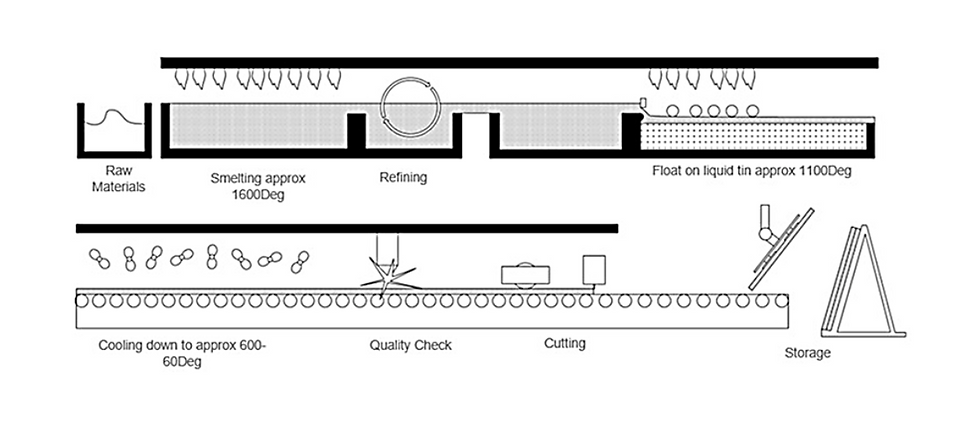
Optical distortion occurs when light passing through glass is refracted in unintended ways. In a perfect pane of architectural glazing, both surfaces would be completely flat and parallel, allowing light to refract consistently across the surface. In reality, even slight variations in surface flatness or internal stresses can change how light behaves, resulting in visible distortions in reflection or transmission.
The challenge becomes greater in modern multi layered systems. Today’s facades typically incorporate insulated glass units composed of heat treated and or laminated panes separated by a sealed cavity. Each stage of processing can introduce subtle surface or stress variations, and when combined within a single unit these effects may interact or amplify. Despite this, practical and widely adopted methods for assessing and controlling optical distortion, whether in production or on site, remain limited.
At Henriksen Studio, we work at the intersection of facade engineering and Passivhaus design. While thermal efficiency, airtightness and durability are critical, the visual quality of glazing is equally important.
In this article, we explore optical distortion in architectural glazing, the main categories of distortion, how it is assessed, as well as possible future research directions and next steps for the industry.
What is optical distortion in glass?
Optical distortion in glass refers to the visual deformation of images seen in reflection or transmission through a glazed panel. In simple terms, straight lines may appear bent, rippled or magnified when viewed through or reflected in the glass.
In theory, a perfect pane of architectural glazing would have two completely flat, parallel surfaces. When light passes through such a pane, the refraction angle at the surface is consistent across the pane, meaning there is no visible change to the image. (Note: In theory a perfect pane wouldn’t have minor optical effects.)
If the variation angle across the pane is not consistent (particularly for curved glass) the result is glass distortion. In modern facades, where large, insulated glass units, heat treated panes and laminated build ups are common, the optical interactions between these components are more complex than ever.
Although manufacturing standards have improved significantly over recent decades, optical distortions remain inherent to certain production processes. The key question is not whether distortion exists, but how much is acceptable and how can it be controlled.
Main categories of glass distortion in architectural glazing
Optical distortion can arise from different stages of glass processing and assembly. Below are some of the principal categories observed in architectural glazing.
Roller wave and edge dip
Roller wave is one of the most widely recognised forms of glass distortion. It occurs during the toughening or heat strengthening process, when glass softens at high temperatures and passes over furnace rollers. Slight sagging between the rollers creates a subtle wave pattern aligned with the direction of travel.
At the same time, the glass edges may cantilever between rollers, creating a localised dip or edge lift.
These effects are inherent in thermally pre-stressed glass. While unavoidable to some degree, their magnitude can be measured and limited in accordance with European standards. Thinner glass is generally more susceptible.
Distortion from polishing
On site or in the factory, local polishing may be undertaken to remove scratches or surface damage. However, mechanical polishing discs can create slight curvatures in the surface, particularly if applied unevenly.
This localised reshaping of the surface can introduce lensing effects or swirling distortions, visible in both reflection and transmission. Beyond aesthetic concerns, excessive polishing may also affect structural performance.
Lensing effect
Lensing refers to a magnification or enlargement of images seen through a glazed unit. It often affects the majority of an insulated glass unit rather than just an edge zone.
In architectural glazing, lensing can result from:
• Alignment of roller wave patterns in laminated plies
• Variations in interlayer thickness
• Excessive clamping during lamination
• Combined effects within insulated glass units
When multiple layers of glass are combined, distortions can compound or amplify each other, making the visual effect more pronounced.
Linear and localised edge distortion
Edge distortions may appear either along the length of an edge or at discrete points. Unlike roller wave, which follows the glass furnace direction, these distortions may run perpendicular to it or appear irregular.
Potential causes include uneven polishing, handling stresses or lamination processes. These distortions are particularly noticeable in large format architectural glazing with strong reflections.
Dishing
Dishing, sometimes known as quench dishing, occurs during rapid cooling of heat treated glass. If edges cool faster than the centre, differential contraction can cause the central area to buckle slightly, forming a distortion pattern.
In reflection, this can appear as a soft depression or crease in the centre of the pane.
Anisotropy
Anisotropy, sometimes called leopard spots, differs from other forms of glass distortion. It does not change the geometry of reflected or transmitted images. Instead, it produces visible patterns or rainbow like effects caused by residual stresses from the heat treatment process.
These patterns are often visible under polarised light and may appear as alternating light and dark zones. While technically not a surface geometry issue, anisotropy is still a visual phenomenon that affects the appearance of architectural glazing.
Longitudinal fine wave
Longitudinal waves appear as narrow or wider bands running along the pane. They may originate from quench roller markings, air nozzle placement or minor temperature differentials within the glass furnace.
Depending on their width and frequency, they can produce subtle but noticeable distortions in reflection.
How do we measure glass distortion?
One of the challenges facing the facade industry is the lack of comprehensive methods for assessing optical distortion in complex, multi-layer glazing systems.
Visual grid and zebra board methods
Established European standards assess monolithic glass using black and white stripe screens positioned at controlled distances. The glass is rotated through specified angles and the point at which distortion becomes visible is recorded.
If distortions appear below defined viewing angles, the pane may fail the criteria.
This approach is practical in factory settings but is often difficult to replicate on site, due to space constraints and the inability to rotate installed panels.
Digital photography and image analysis
ASTM methods (test procedures and technical standards published by ASTM International, formerly known as the American Society for Testing and Material) use digital photographs of reflected or transmitted grids. Computer analysis compares the captured image against the original grid to quantify deviations.
This technique offers a more objective approach and can characterise roller wave and other distortions with measurable outputs.
Measurement in millidiopters
A promising direction is to measure distortion in millidiopters, a unit that quantifies angular deviation of light. Rather than controlling only physical causes such as roller wave amplitude, this approach directly measures the optical effect experienced by the viewer.
Such objective metrics could enable clearer specification criteria for architectural glazing, independent of the exact build up.
Reflective and transmissive testing
Laboratory studies have shown that reflective tests using angled stripe boards can reveal swirling or wavy patterns, while transmissive tests highlight distortion at increasing viewing angles.
In some cases, distortion that appears subtle at perpendicular viewing becomes excessive at oblique angles. This has significant implications for tall facades and glazed corners where oblique views are common.
What impact does glass distortion have on our buildings?
The impact of glass distortion is primarily visual, but its consequences can be commercial and reputational.
Aesthetic quality
Modern facades often rely on crisp reflections and visual clarity. Distortion can disrupt reflected sky lines, adjacent buildings or internal views. In high profile developments, even minor deviations can attract attention and concern.
User perception
Occupants may perceive distorted reflections or magnified views as defects, even if technically compliant with standards. Human perception varies according to viewing distance, angle and lighting conditions.
Amplification in complex build ups
Distortion may be minimal in individual plies but amplified once assembled into laminated or insulated glass units. As glazing specifications become more complex, particularly in high performance Passivhaus envelopes, understanding cumulative effects is essential.
What next for architectural glazing?
The industry is seeing a growing focus on optical quality alongside thermal and structural performance. At Henriksen Studio, we believe that next steps for our industry could include:
1. Improved measurement criteria
While existing standards attempt to address optical faults, they do not comprehensively account for all observed phenomena - particularly in insulated glass units (IGUs) with complex build-ups incorporating heat-treated and laminated glass.
In addition, there is still a degree of uncertainty and inconsistency among facade contractors and glazing manufacturers regarding these effects. Taken together, these gaps highlight a clear industry need for more robust approaches to the characterisation, measurement, and control of optical distortion in IGUs.
2. On site assessment methods
Practical tools for on-site measurement would enable early identification of issues before handover, reducing disputes and remedial work.
3. Integration into facade design
For Passivhaus projects, optical performance should be considered at concept stage alongside U values, solar control and airtightness. Viewing angles, panel sizes and facade orientation all influence perception of glass distortion.
A balanced approach to glass distortion
Optical distortion in architectural glazing is not a new phenomenon, but it is becoming more prevalent. While some degree of glass distortion is inherent to manufacturing processes such as heat treatment and lamination, its magnitude can and should be controlled.
The future lies in moving from subjective visual judgement to objective optical measurement. By doing so, the industry can better define acceptable limits, align expectations and improve quality across increasingly complex glazing systems.
At Henriksen Studio, we believe that glass should not only perform thermally and structurally, but it should look as intended. We work in close partnership with clients, architects, and glass manufacturers to ensure every project achieves exceptional standards of quality, performance, and visual clarity. From early-stage design development through to installation oversight, we deliver informed, end-to-end support at every phase of the process.
If you want to read more about optical distortions in glass, our founder Dr. Thomas Henriksen, alongside Edwin Stokes, Christian Louter and Mauro Overend has recently published a research paper: Optical distortions in architectural glass: review of categorization, evaluation and measurement methods. The paper provides a review of methods to determine optical distortion in architectural glass, with a focus on the methods described in the current available standards and guidelines.


